Structural steel is the material that makes modern construction possible at the scale and pace the built environment demands today. It forms the load-bearing frameworks of skyscrapers, spans the gaps of bridges, supports the roofs of warehouses and stadiums, and carries the platforms of industrial facilities across the globe. But structural steel is not a single, uniform product — it is a broad family of section types, each engineered with a specific cross-sectional geometry to resist particular load types efficiently and economically. Choosing the right structural steel products — and understanding how steel columns, beams, angles, channels, and hollow sections each contribute to a structural system — is fundamental to any successful construction or engineering project in the Middle East.
Why Structural Steel Remains the Preferred Construction Material
- Outstanding strength-to-weight ratio: Steel delivers more load-carrying capacity per kilogram of material than virtually any other common structural material.
- Design flexibility: Steel sections can be cut, welded, bolted, and combined in an unlimited variety of configurations to suit almost any architectural or engineering requirement.
- Speed of construction: pre-fabricated steel frameworks can be erected on site significantly faster than equivalent reinforced concrete structures, reducing project timelines and site costs.
- Dimensional consistency: Structural steel sections are manufactured to tight dimensional tolerances, reducing fabrication errors and simplifying connection design.
- Sustainability: Steel is one of the most recycled materials in the world — structural steel contains high percentages of recycled content and is fully recyclable at end of life.
Main Types of Structural Steel Products
Universal Beams (UB) — I-Beams and H-Beams
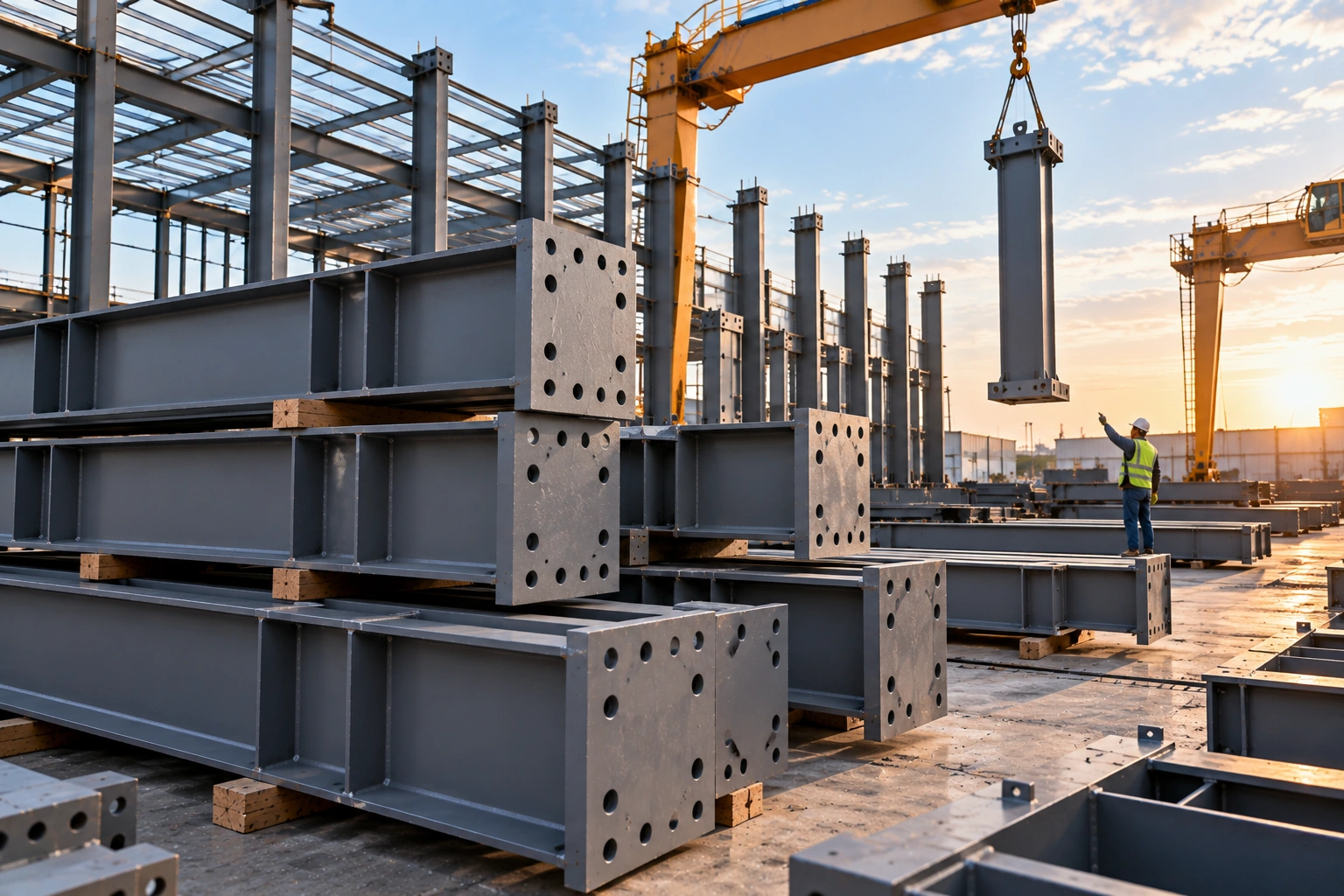
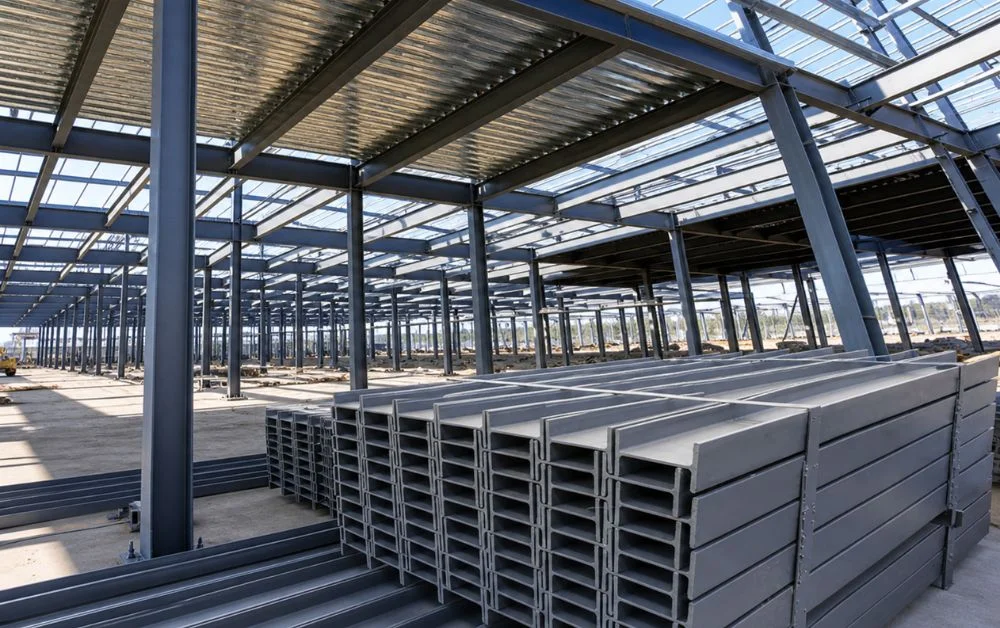
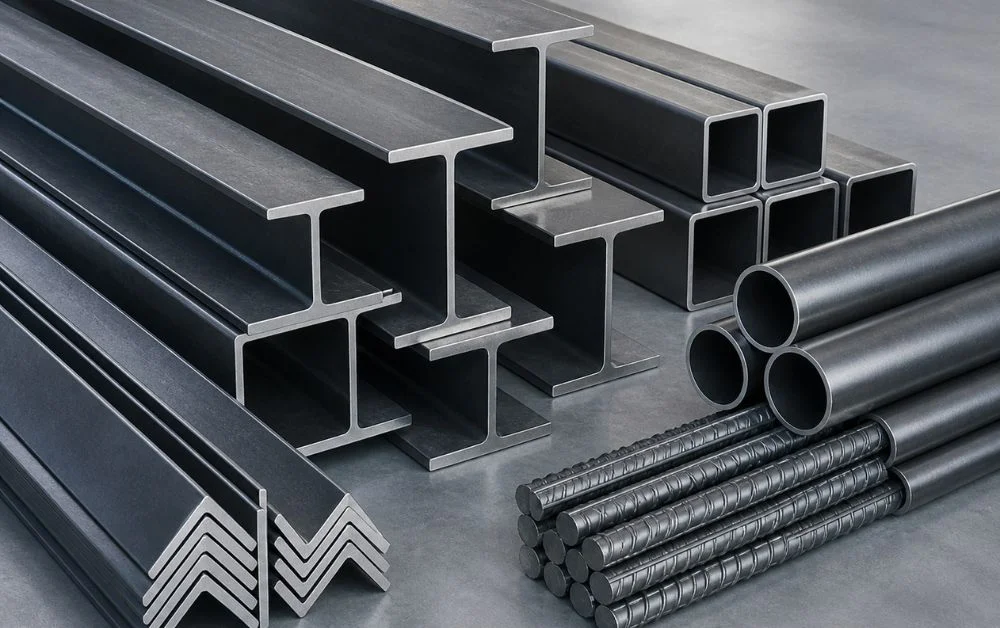
Universal beams have an I-shaped or H-shaped cross-section with wide flanges connected by a central web. They are the most widely used structural section in construction because their geometry is optimized for resisting bending loads efficiently — most of the steel mass is concentrated in the flanges where bending stresses are highest. Universal beams are used for floor beams, roof beams, bridge girders, crane rails, portal frames for industrial buildings, and a vast range of other structural applications across every sector of construction.
Steel Columns — Universal Columns (UC)
Steel columns, also known as universal columns or UC sections, have a cross-section with nearly equal width and depth dimensions — fundamentally different from universal beams which are deeper than they are wide. This proportional geometry makes steel columns ideal for carrying axial compressive loads — the vertical loads transferred downward through a structure to its foundations. Steel columns are the vertical load-carrying members in multi-story building frames, industrial structures, mezzanine floor supports, and bridge substructures. Correctly sizing and specifying steel columns for the applied loads and buckling length is a critical structural engineering task that directly affects the safety and economy of the structure.
Structural Steel Angles
Angle sections have a simple L-shaped cross-section with two legs meeting at a right angle. They are available in equal angle (both legs the same length) and unequal angle (legs of different lengths) configurations. Despite their geometric simplicity, angles are among the most versatile structural sections used in construction and fabrication. They are widely used for structural bracing, secondary framing members, shelf angles, bracket connections, gusset plates, purlins, wall ties, and as connection components in bolted and welded structural assemblies. Their economy, versatility, and ease of fabrication make them ubiquitous in every type of construction.
Related read:-How to Choose the Right Steel Columns for Your Construction Project
Structural Steel Channels (C-Sections)
Channel sections have a C-shaped cross-section — two flanges connected by a web on one side only — that provides good bending resistance in one axis while allowing easy connection to other members. They are commonly used as roof purlins and wall girts in steel-framed industrial and agricultural buildings, as secondary framing members, as conveyor support structures, as retaining wall components, and in mechanical equipment frames and supports.
Hollow Sections — SHS, RHS, CHS
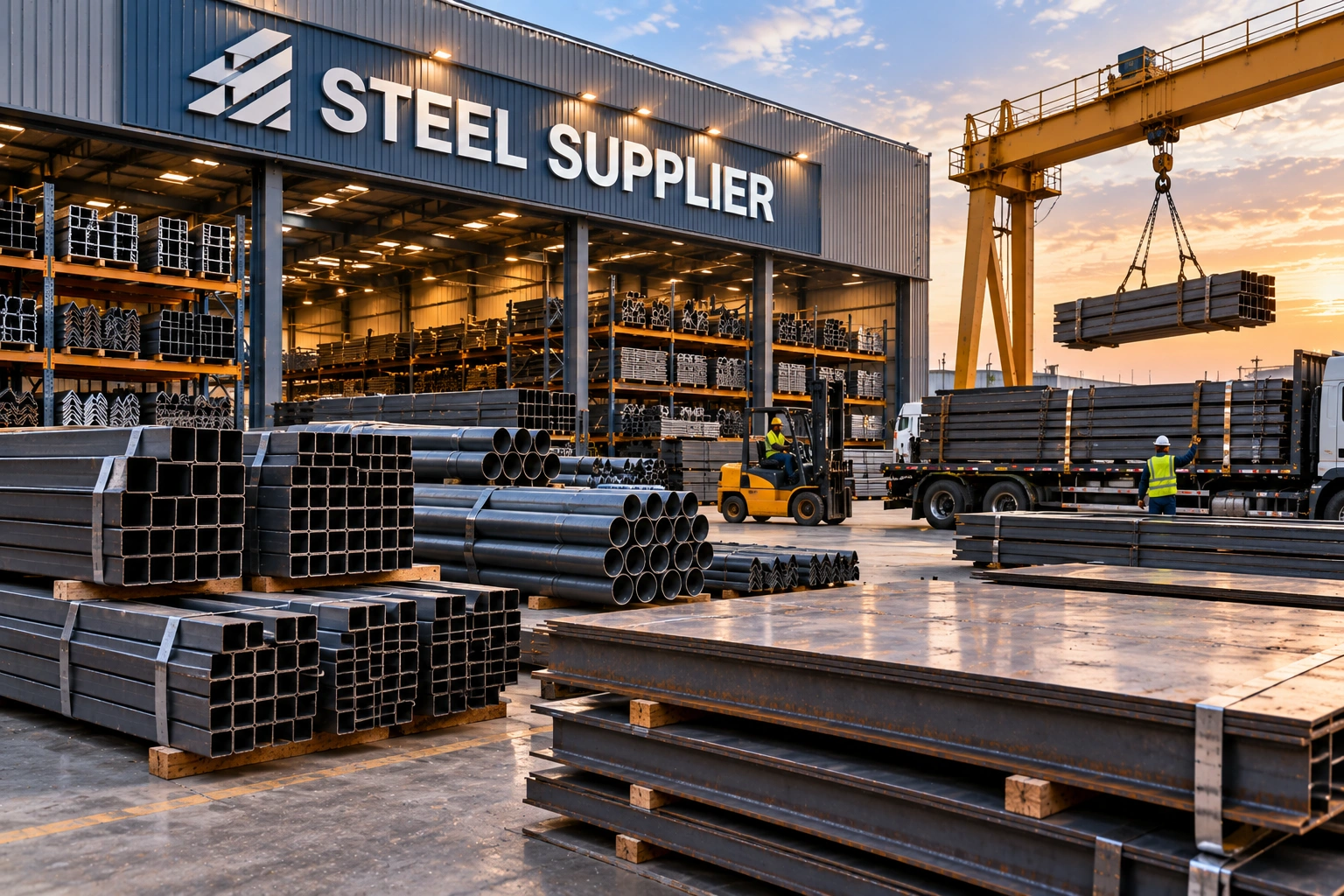
Square hollow sections (SHS), rectangular hollow sections (RHS), and circular hollow sections (CHS) combine structural efficiency with excellent torsional rigidity and a clean, architecturally appealing closed form. They are used for exposed structural columns and frames in architectural steelwork, handrails, gates and fencing, offshore and marine structures, compression members in trusses and bracing, and mechanical equipment frames where closed sections are preferred for their clean appearance and torsional properties.
Critical Factors in Structural Steel Selection
- Match section type to load type: Beams resist bending; columns resist compression; bracing members resist tension or compression; hollow sections resist torsion and combined loading.
- Consider span and load magnitude: Longer spans and heavier loads require deeper or heavier sections — always design to the applicable standard.
- Account for environmental conditions: Corrosive environments require galvanized, painted, or stainless-steel products. Coastal and offshore applications demand higher levels of corrosion protection.
- Ensure code compliance: All structural steel must be designed and specified to comply with the applicable building code and material standard — AISC, EN, BS, or local equivalents.
- Verify certifications: Always obtain mill test certificates confirming the material’s mechanical properties and grade compliance for every batch of structural steel.
Conclusion
Selecting the right structural steel products — from universal beams and steel columns to hollow sections, angles, and channels — is a decision with direct implications for the safety, performance, and economy of every construction project. Sydney Metal Trading LLC supplies a comprehensive range of structural steel products across the Middle East, providing high-quality certified materials, expert technical guidance, and reliable delivery to ensure your project gets exactly the steel it needs, when it needs it.